Breed guide
What Is a Maltipoo? The Complete Breed Guide
Everything the breed pages tell you, plus the Singapore parts they leave out: the size band that actually turns up here, the HDB question, the grooming bill, and the reason some homes should not get one. Written by the people who have placed 100+ of them.
Jump to the guide libraryWhat is a Maltipoo?
A Maltipoo is a small companion dog: a crossbreed of a Maltese and a Toy or Miniature Poodle, so it is often called a Maltese Poodle mix. In the toy sizes placed in Singapore it finishes at 2 to 4kg with a soft, low-shedding coat, pairing Maltese devotion with Poodle cleverness. It is a companion cross, not a recognised pure breed.

2–4kg
Adult weight, toy sizes
20–30cm
Height at the shoulder
12–15 yrs
Lifespan, commonly cited
$3,288
All-in, in Singapore
Where the Maltipoo comes from
The formula is simple and it is the whole answer to what is a Maltipoo: one Maltese, one Poodle, usually a Toy Poodle in Singapore because the toy result is what flats want. The Maltese brings the devotion, the white-to-cream coat and a watchdog streak that has been shrunk but not deleted. The Poodle brings the brain, the curl and the low-shed coat. Neither parent was ever bred to work; both were bred to sit with people, which is why the cross behaves the way it does.
You will see generation labels attached to the maltipoo dog. F1 means a straight Maltese-to-Poodle cross, the most common. F1b means an F1 Maltipoo bred back to a Poodle, which usually tightens the curl and lowers shedding further, at the cost of a coat that mats faster in humidity. Neither label is a quality grade. What it tells you is roughly what coat you are signing up to brush.
One thing to be clear about, because the Google panel calls it a dog breed: a Maltipoo is not a recognised pure breed. It is a companion cross, and it is judged by how it lives with a family rather than against a written standard. That also means adult size varies more than it would in a pure breed, which matters when you are buying a puppy for a flat.
The cross, at a glance
- Maltese × Toy or Miniature Poodle
- F1 = first cross · F1b = crossed back to Poodle
- Not a kennel-club recognised breed
- Both parent breeds bred purely as companions
- Toy Poodle parent = the 2–4kg result
What a Maltipoo looks like full grown
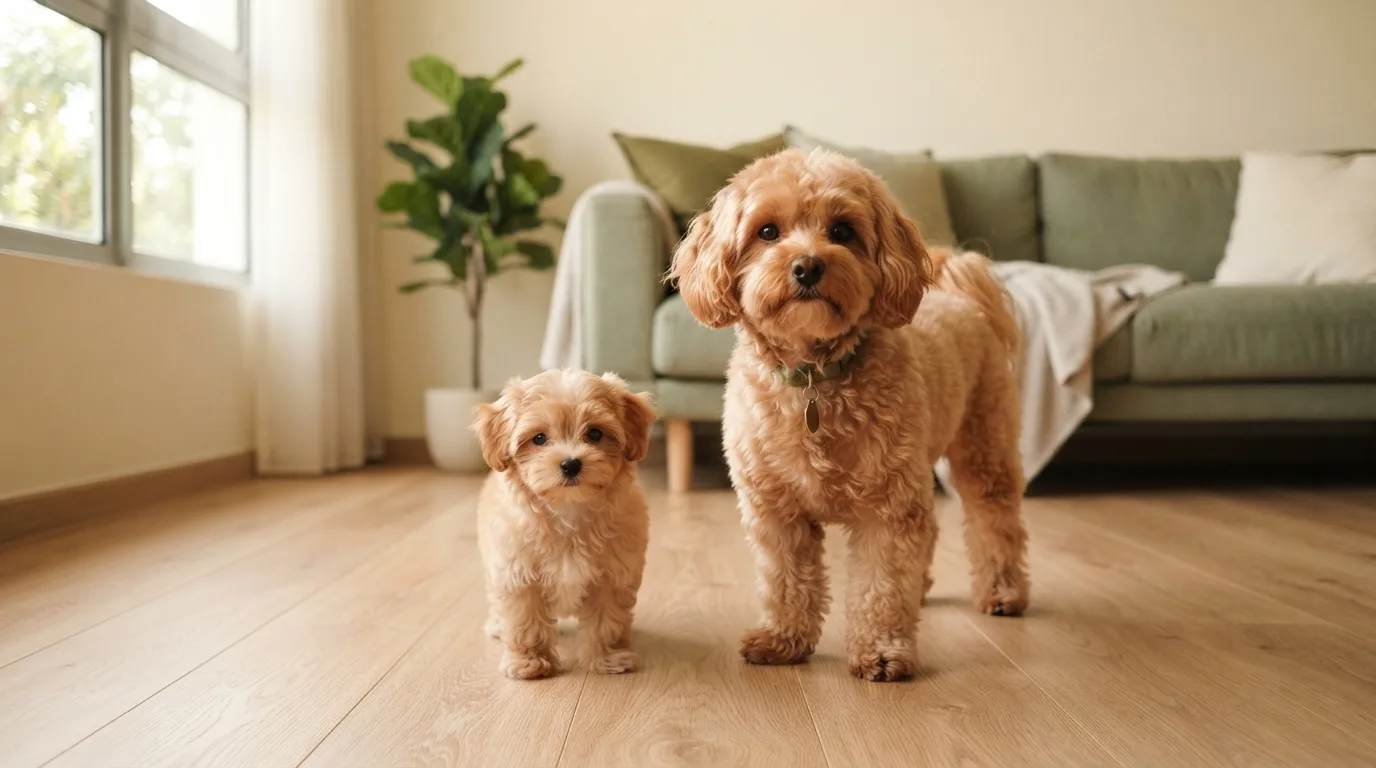
The toy Maltipoos we place finish at 2 to 4kg and roughly 20 to 30cm at the shoulder, usually reaching adult size somewhere around ten to twelve months. That is smaller than the ranges you will read on overseas breed pages, and the reason is simply which Poodle parent is used: a Miniature Poodle side produces a noticeably bigger dog. If a listing anywhere quotes you a weight, the useful follow-up question is about the Poodle, not the Maltese.
Coats run from loosely wavy to properly curly, and the texture usually settles by the first or second groom rather than at eight weeks. Colour is where Singapore differs from the textbooks: apricot dominates what actually arrives here, with cream and white next, and black or brown far rarer. The colours guide covers how puppy coats lighten as they mature, which surprises a lot of first-time owners. For the numbers in detail, the full grown size guide and the honest take on toy, teacup and mini labels go further than this page can.
Maltipoo temperament and characteristics
If you take one maltipoo characteristic away from this guide, make it this: a Maltipoo wants company, and it wants it most of the day. It follows you room to room, naps against your leg rather than across the room, and usually elects a favourite person while loving the rest of the household on retainer. Owners describe it as a velcro dog, and that is accurate rather than cute.
The Poodle side shows up as speed of learning. Toilet training lands quickly for a toy breed, basic cues stick in days, and puzzle games tire it out as effectively as a walk does. The flip side of clever is that a bored Maltipoo invents its own job, usually a loud or chewy one. The temperament guide maps which households this suits and which it does not, and the Maltipoo vs Cavapoo comparison is the honest side-by-side for anyone whose flat empties out on weekdays.
Maltipoo traits, condensed
- Velcro attachment, favourite-person tendency
- Quick to learn, quick to get bored
- Alert-vocal rather than yappy
- Gentle indoors, low exercise needs
- Generally good with cats and other dogs
What a Maltipoo puppy is actually like
A Maltipoo puppy goes home at about nine weeks here, after the vaccinations at weeks six and eight, with the third at week twelve and an optional fourth at sixteen. Expect a dog that weighs about a kilogram, sleeps enormously, and attaches to you within days. The first night is the hard one; the first week home guide covers the pen setup that shortens it.
Two things surprise first-time owners. The first is how fast toilet training moves once the routine is consistent, which is the Poodle brain earning its keep, though HDB living adds the pee-pad-versus-downstairs decision covered in the potty training guide. The second is the teething bite: sharp, relentless, and entirely normal from roughly twelve to twenty weeks. Neither is a temperament problem. The first professional groom is worth booking early too, not for the haircut but so the puppy learns that clippers are boring.
Every puppy we place includes a first lesson with an AVS-certified trainer, which usually ends with a sit, a recall and a very smug puppy. The training guide and the growth stages guide pick up from there.
The Maltipoo puppy timeline
- Vaccinations weeks 6, 8 and 12 (optional 16)
- Home at about week 9, around 1kg
- Teething bite: roughly weeks 12–20
- First salon groom: after the vaccination course
- Adult size: about 10–12 months
Grooming and care in Singapore’s climate
A low-shedding coat is not a low-maintenance coat, and Singapore makes that point harder than most countries do. Hair that does not fall out gets caught in the coat instead, and humidity plus a damp dog after a walk turns loose tangles into felt faster than owners expect. A few minutes of brushing most days is the whole trick, plus drying properly after every bath rather than letting the aircon do it.
Professional grooming runs every four to six weeks. Singapore salon rates for a toy-size dog sit roughly in the $50 to $130 range depending on coat length and how far things have been left, which is the biggest recurring cost of owning one. Light faces also show tear staining, which is cosmetic far more often than it is medical. The grooming and haircuts guide covers the teddy bear cut and the salon conversation; the shedding and allergies guide gives the honest version of hypoallergenic, which is lower-allergen, not allergen-free.
The coat routine that works here
- Brush most days, not weekly
- Salon every 4–6 weeks
- Singapore market rate: about $50–$130 a session
- Dry thoroughly after every bath
- Walk early or late, not midday
Maltipoo health and lifespan
Maltipoos are commonly cited as living 12 to 15 years, and plenty go beyond it. Small dogs outlive large ones as a class, and the things that move the number are unglamorous: keeping the dog lean, brushing its teeth from puppyhood, and not skipping the annual check and booster.
The health issues worth knowing are the ones both parent breeds contribute. Luxating patella, the slipping kneecap common in toy breeds, is the one to ask a vet about at the first check. Dental disease is the quiet one, because small jaws crowd teeth and gum trouble in a toy dog does not stay in the mouth. Eye and tear-duct irritation shows up on light-coloured faces. None of this is a reason not to buy one; it is a reason to buy from somewhere that will still take your call in year three. The lifespan and health guide goes through each of these properly.
What to watch for
- Luxating patella — ask at the first vet check
- Dental disease — brush from week one
- Tear-duct irritation on light faces
- Weight creep — the biggest lifespan lever
- Annual booster from year one
The honest downsides of a Maltipoo
Every breed page has a section like this and most of them are padding. Here is the real list. The attachment that makes a Maltipoo wonderful does not switch off when you leave, so a flat that is empty from morning to evening every weekday produces a stressed dog and an unhappy corridor. That is the disqualifier, and it disqualifies more homes than people expect.
After that: it is more vocal than the average small companion breed, so alert barking needs training rather than tolerating. The coat costs real money and real minutes, forever. At 2 to 4kg it is genuinely fragile, so toddlers need supervising more than the dog does. Adult size is less predictable than in a pure breed. And it is not a cheap dog to buy here, before you have spent a cent on grooming.
If several of those land badly, that is useful information, not a failed search. The breed comparisons exist for exactly that moment, and our sister shop places Cavapoos for the households that need a dog to cope with a working day alone. We would rather tell you that now than take your money.
The trade-offs, plainly
- Hates being alone all day — the real dealbreaker
- More vocal than average
- Grooming is a permanent cost
- Toy size is delicate around toddlers
- Adult size varies more than a pure breed
Is a Maltipoo right for a Singapore home?
The flat is almost never the problem. HDB’s approved list includes both parent breeds, the Maltese at number 33 and the Toy Poodle at number 42, and a cross of two approved small breeds is accepted. A 2 to 4kg dog also fits the one-dog HDB rule and the lift and void-deck realities of block living without effort. The HDB guide sets out exactly what to say if anyone questions it.
What decides the outcome is the weekday schedule inside the flat. Retirees, work-from-home owners, families with a helper or a grandparent at home, households where someone comes and goes through the day: these are where Maltipoos thrive, and they are most of our 100+ placements. The climate needs managing rather than fearing, which mostly means early or late walks and drying the coat properly.
Cost, for completeness, sits in the price guide, and the ongoing side, licence tiers and all, is in the real cost of ownership. Neither is the hardest question. The hardest question is who is home at 2pm on a Wednesday.
Singapore fit checklist
- HDB: cross of two approved breeds — accepted
- Maltese #33 · Toy Poodle #42 on the list
- Size suits a flat and the one-dog rule
- Someone home most of the day: essential
- Early or late walks, dry the coat properly
The complete Maltipoo guide library
This page is the overview. Every question below has a guide of its own, written the same way: Singapore figures, real placements, and the parts other sellers skip.
How big do Maltipoos get
The full grown weight and height band, and why the Poodle parent decides more than the Maltese one.
SizeToy, teacup and mini, honestly
What those labels actually mean in Singapore, and which ones are marketing.
CoatMaltipoo colours
Apricot, cream, white, black and brown, and which ones actually turn up here.
CharacterTemperament and personality
The velcro attachment described accurately, including the part that is hard work.
CareGrooming and haircut styles
Brushing cadence, salon intervals, real Singapore prices, and the teddy bear cut.
HealthLifespan and health issues
How long they live, what goes wrong in toy breeds, and the vaccination schedule.
TrainingTraining a Maltipoo puppy
Why the Poodle brain makes this easy, and the first lesson included with every puppy.
SingaporeAre Maltipoos HDB approved
The rule, the two approved parent breeds, and what to say if anyone questions it.
CostPrice in Singapore
What a Maltipoo costs here, all-in, and what the market range looks like elsewhere.
CostThe real cost of ownership
Licence tiers, grooming, food and vet care after the puppy price is paid.
CompareMaltipoo vs six other breeds
Maltese, Cavapoo, Toy Poodle, Bichon Frise, Shih Tzu and Cockapoo, verdict by verdict.
CoatShedding and allergies
What low-shedding really means, and the honest version of hypoallergenic.
BehaviourDo Maltipoos bark a lot
The vocality question answered straight, with the HDB courtesy line in mind.
BehaviourBeing left alone
The single biggest reason a Maltipoo placement goes wrong, and how to test for it.
PuppyThe first week home
What week nine looks like, the starter kit, and surviving the first night.
PuppyPotty training
Pee pads versus downstairs in an HDB flat, and a realistic timeline.
PuppyGrowth stages
When a Maltipoo stops growing, and what to expect month by month.
LocalMaltipoo in Chinese
What to call the breed when the family asks, and why the name varies.
Ready to look rather than read? See the available Maltipoo puppies in the shop right now.
Maltipoo questions people actually ask
Is a Maltipoo a good dog to have?
For the right routine, one of the best small companions you can own: gentle indoors, quick to learn, small enough for an HDB flat and low-shedding. The condition is company. Households where someone is usually home get a devoted dog; flats that empty out all day get a stressed, vocal one.
Is a Maltipoo a good house dog?
Yes, and unusually so. At 2 to 4kg it needs very little space, exercises happily indoors, and settles on a lap rather than patrolling. Both parent breeds are HDB approved, so the flat is rarely the problem. The daily schedule inside it is what decides the outcome.
What is a common problem with Maltipoo?
Separation-related stress is the most common, and it drives the second most common: barking. After that come coat matting if brushing slips, tear staining on light faces, and small-dog dental disease. Every one of those is manageable, and every one of them is a routine problem before it is a medical one.
What are the negatives of a Maltipoo?
It does not like being alone, it is more vocal than the average small companion breed, the coat needs brushing at home plus a salon visit every four to six weeks, and at toy size it is physically delicate around toddlers. As a cross, adult size is also less predictable than in a pure breed.
Is a Maltipoo high maintenance?
Grooming, yes: a few minutes of brushing most days and a professional groom every four to six weeks, which in Singapore runs roughly $50 to $130 a session depending on coat length and salon. Exercise, no: two short walks and indoor play suit a toy dog. Company is the real maintenance cost.
Is a Maltipoo a yappy dog?
Not naturally yappy, but genuinely alert. Expect barking at the door chime and corridor footsteps rather than constant noise. Where it tips into yappy is loneliness and boredom. Early quiet-marker training plus enough daytime company keeps a Maltipoo well inside HDB’s considerate-ownership line.
Do Maltipoo bark a lot?
More than a Cavapoo, less than a terrier. The Maltese watchdog streak survives the cross, so they announce arrivals. Volume is a symptom, not a trait: when an owner reports a barking problem, the calendar almost always shows a flat that is empty from morning to evening.
Can Maltipoo dogs be left alone?
Short stretches, yes, with a settled pen routine and something to chew. A full working day, every weekday, no. That routine suits a more independent breed, and we will say so before you buy rather than after. It is the single most useful question to answer honestly about yourself.
What is the lifespan of a Maltipoo?
Commonly cited at 12 to 15 years, with well-cared-for dogs going beyond. Small breeds outlive large ones as a class. Weight control, daily tooth brushing from puppyhood and keeping up with annual vet checks move that number more than anything you can buy.
How big does a Maltipoo get?
The toy Maltipoos we place finish at 2 to 4kg and roughly 20 to 30cm at the shoulder, usually by about ten to twelve months. Crosses using a Miniature Poodle parent instead of a Toy run larger. Ask about the Poodle side before you ask about the Maltese side.
Is a Maltipoo a purebred dog?
No. A Maltipoo is a deliberate cross of two pure breeds, the Maltese and the Toy or Miniature Poodle, and is not recognised as a breed by kennel clubs. That is a description, not a criticism: it is bred as a companion, and it is judged by how it lives with people rather than by a standard.
How much is a Maltipoo in Singapore?
Ours are $3,288–$5,988 all-in, which covers vaccinations to date, microchipping, the licence transfer, a health check and the first trainer lesson. Other Singapore shops advertise from around $3,288 to just under $5,000, though what is bundled into that figure varies a great deal.
Meet your Maltipoo
Come say hello at Balestier
2 Balestier Road #01-701, Singapore 320002 · Weekdays 12pm–6pm · Weekends 10am–6pm. Or message us first: tell us about your home and routine, and we'll tell you honestly if a Maltipoo fits.
Not sure it is the right breed?
Compare the Maltipoo against six other small breeds before you decide anything.
See the comparisons