Training
Training a Maltipoo puppy in Singapore
Quick learner, two breed-specific priorities most guides miss, and a free first lesson to start you right.
Ask about the free lessonHow to train a Maltipoo?
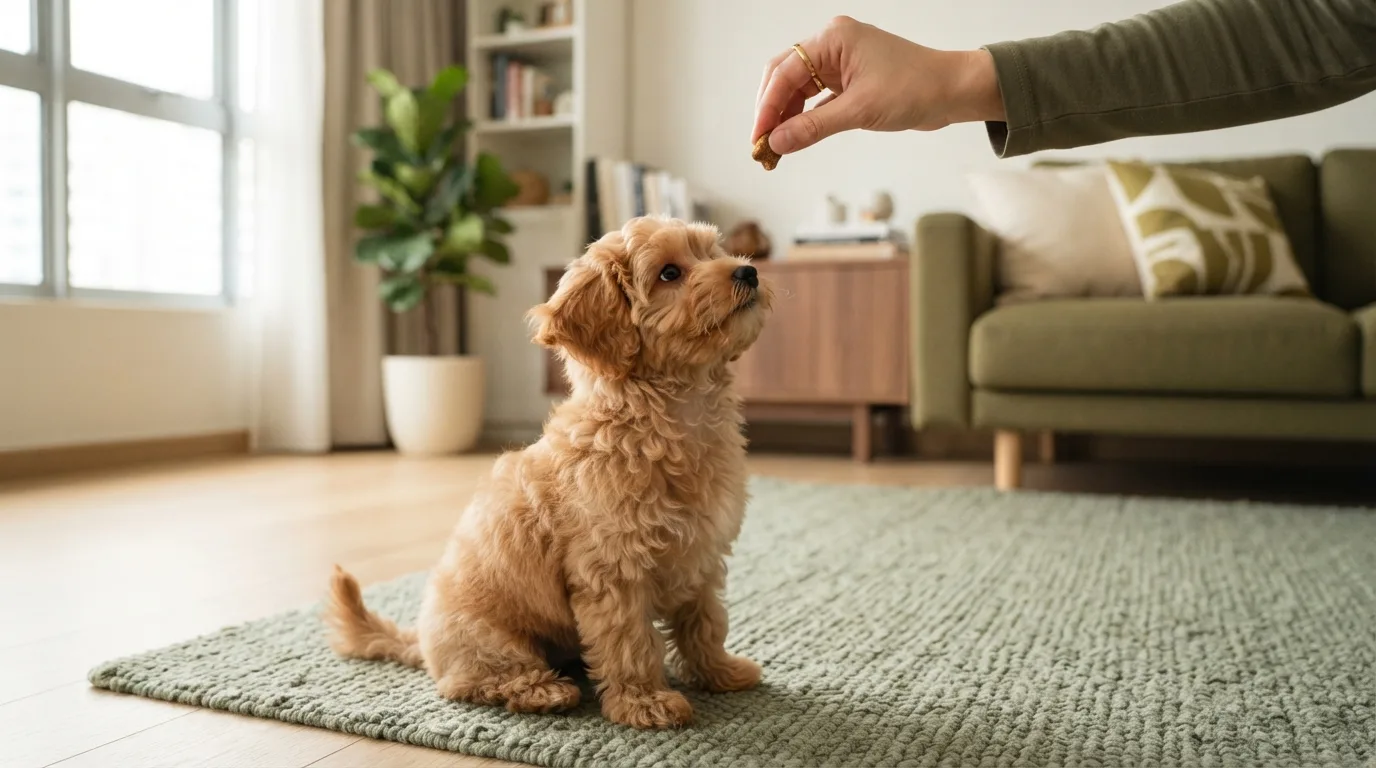
Maltipoo training moves fast thanks to the Poodle side: toilet training, basic cues and tricks land quickly with positive reinforcement. The two non-negotiables for this breed are early quiet-marker training (it is vocal) and alone-time conditioning from week one (it is attachment-dependent).
Toilet training in a flat
Maltipoo potty training runs on schedule, not scolding. Decide the toilet spot before the puppy arrives: pee pad in a fixed corner of the playpen zone, or downstairs on a schedule, but not both at once. The playpen we set up at delivery anchors the whole routine; puppy wakes, eats or finishes play, puppy goes to the spot, reward lands on target.
The honest timeline is four to twelve weeks, and the variable is the humans. A schedule kept at 80% consistency trains slowly; kept at 100%, a clever puppy gets it startlingly fast. Scolding teaches hiding, not holding, so skip it entirely.
Toilet training, condensed
- One spot, decided before day one
- After every meal, nap and play: to the spot
- Reward on target, never scold misses
- Honest timeline: 4 to 12 weeks
Quiet training for a vocal breed
The temperament guide is upfront: this is an alert-barking breed. So quiet is a trained skill, not a hope. Mark and reward the moment of silence after an alert bark ("quiet", treat), rehearse the door chime on purpose at low stakes, and never shout over barking; to a dog, that is joining in.
The payoff is measured in neighbour relations: HDB's courtesy guidance names continuous barking as the line, and a Maltipoo taught quiet in week one never gets near it.
Quiet, step by step
- Reward the silence, not the bark
- Rehearse door chimes deliberately
- Never shout over barking
- Start week one, before habits set
Alone-time conditioning from week one
This breed's biggest training need is the one nobody posts reels about. Because a Maltipoo is attachment-dependent, being alone must be taught in doses: step out for two minutes and return calmly, then five, then twenty, with the pen holding a chew and the departure kept boring. The pen is the safe place, never the punishment place.
A note from the shop floor: the classic mistake is taking leave for the puppy's first fortnight, being home around the clock, then returning to work cold turkey. Condition the absences from day one, even while you are home, and the separation spiral never starts.
Alone-time protocol
- Two minutes first, build in doses
- Departures and returns kept boring
- Pen = safe place, chew inside
- Practise while on leave, not after it
Your free first lesson
Every puppy from us includes a first lesson with an AVS-certified trainer, usually within the first weeks home. Maltipoo intelligence makes one good session go far: it covers the foundations above, tuned to your flat and routine, and sets the marker habits so everything after gets easier.
After that, our WhatsApp thread stays open: training questions, the odd regression during adolescence, and the reassurance that whatever your puppy just did, we have seen it before.
Included with every puppy
- First lesson, AVS-certified trainer
- Tuned to your home and routine
- Ongoing advice on WhatsApp, no expiry
Marker training, and the adolescence wobble
Every command on this page installs faster with a marker: one word ("yes") or a clicker, always followed by a treat within a second. A Maltipoo's food drive and people-focus make it a natural marker-training student; five-minute sessions, twice a day, beat one ambitious half-hour that outlasts a puppy attention span.
Then, around month six, the trained puppy appears to uninstall itself: recall slows, "sit" gets a thoughtful pause, and the pad routine develops opinions. This is adolescence, not failure. The rules that survive it: never repeat a cue twice (say it once, help the dog succeed, reward), keep rewarding the boring basics you stopped paying for, and hold routines identical while the teenager re-tests them.
The mistakes that cost owners months are consistent across our WhatsApp threads: punishing after the fact (the dog links the punishment to you, not the puddle), free-feeding (which dissolves both toilet schedule and food-reward power), and skipping alone-time drills on work-from-home weeks, which is precisely when separation anxiety takes root.
Hold the line to roughly month eighteen and the adult that emerges is the dog the breed promised: quick, biddable, and convinced your lap is the classroom. Every buyer's first lesson at Balestier covers the marker mechanics in person, free.
Socialisation runs on the same clock as the commands and matters more. Between homecoming and roughly week sixteen, a puppy files every new surface, sound and visitor under "normal"; after that window, novelty defaults to suspicion. Lift rides, umbrella openings, the void-deck badminton game, one calm adult dog: a checklist a week, at the puppy's pace, does more for adult temperament than any sit-stay.
Keep a floor rule under all of it: this breed trains on warmth and food, never on force. A harsh correction that a Labrador shrugs off genuinely frightens a 3kg velcro dog and spends trust you will want during teething month four. If a trainer's method needs a stern voice and a yank, it is the wrong trainer for this page's breed.
Marker rules
- Mark ('yes'/click), treat within 1 second
- 5-minute sessions, twice daily
- Say a cue once, never twice
- Month 6-18: re-testing, not forgetting
- Never punish after the fact
Frequently asked questions
Are Maltipoos easy to train?
Yes, among the easiest of the toy breeds: the Poodle side means cues land in days and toilet training in weeks, provided the schedule stays consistent. The breed rewards routine and forgives beginners.
How long does toilet training take?
Four to twelve weeks is the honest range, driven almost entirely by how consistently the humans run the schedule. Take the puppy to the spot after every meal, nap and play session, reward on target, and skip the scolding; accidents are data, not defiance.
Do I need a clicker?
No; a consistent marker word ("yes!") in the same tone does the same job. Consistency beats equipment in every part of dog training.
How do I stop puppy biting?
Redirect to a chew toy the moment teeth touch skin, and end the game if it continues; attention is the reward, so withdrawing it is the lesson. Teething peaks around four months, which is what the chew toys in the starter kit are for.
When should training start?
Day one at home, in ten-minute sessions. A nine-week-old learns its name, the toilet spot and the beginnings of quiet and alone-time habits in the first fortnight, and those early habits are the cheapest training you will ever do.
Meet your Maltipoo
Come say hello at Balestier
2 Balestier Road #01-701, Singapore 320002 · Weekdays 12pm–6pm · Weekends 10am–6pm. Or message us first: tell us about your home and routine, and we'll tell you honestly if a Maltipoo fits.
Start with the right match
Training is easier when the breed fits the routine. Check yours first.
Take the routine test